← Field notes

A Camera-Happy Temple

Ghousiga Balasubramaniya KoyilBrahmotsavamPurappadu

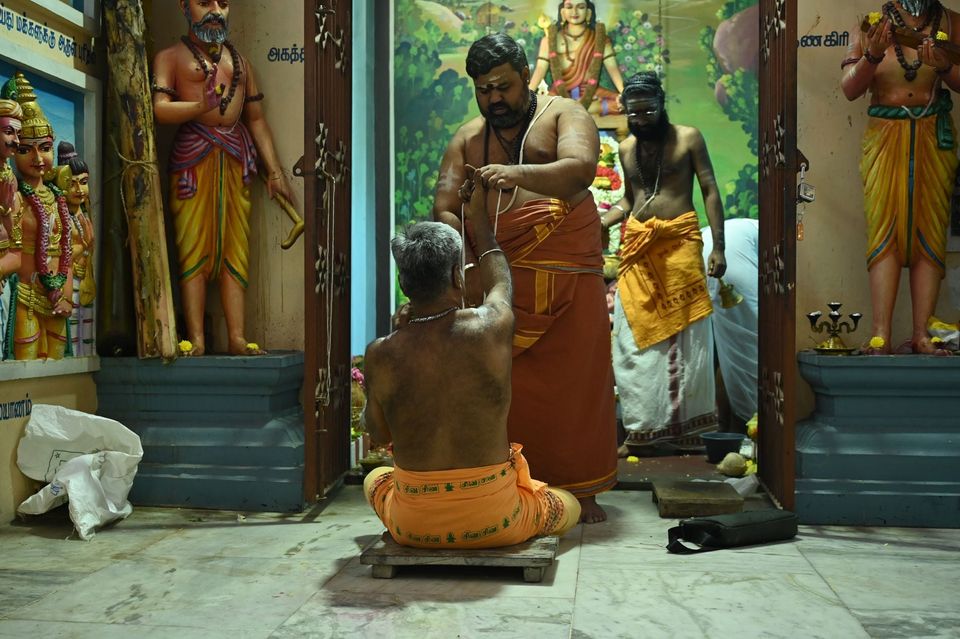
The flag went up at Ghousiga at 630am. We know that precisely because that’s when we got there, thinking it’s roughly when the pujas begin (the patrikai lists times which no temple accurately follows, and we’ve become decent at calculating for lateness, but sometimes just get it all wrong). So then there are Khadir-sir and the younger priest, tying the flag to the kodi maram. The Ghousiga temple has three entrances – one to the south, two facing east, with one of these directly in front of the moola murti. When the queues are long, the queueing lines themselves block the south entrance, and people are guided to the east moola murti entrance. The third entrance is like a private one at this point, controlled from within. We thought we were stuck watching what we could from outside, which wasn’t very much at all. But then someone at the third entrance allowed us to come in, denying another man entry on the grounds that “they [as in we who were let inside] have cameras.”

Wow, I thought. First temple to grant us entry because we have cameras, not in spite of them. It made me think again about what this magical box we carry around with us, to “take” photos–it’s always regarded as taking; one man at Kannika a long time ago had said that, you take so many photos, implying that a few might have been ok, but a lot is a different matter–actually signifies. I’ll leave that musing for later, just noting for now that even in temples with rules stricter than Ghousiga, the photos signal attention–desired, in this socially mediated show-case friendly Instagrammable world. They put the Brahma into the brahmandam, dare I say.

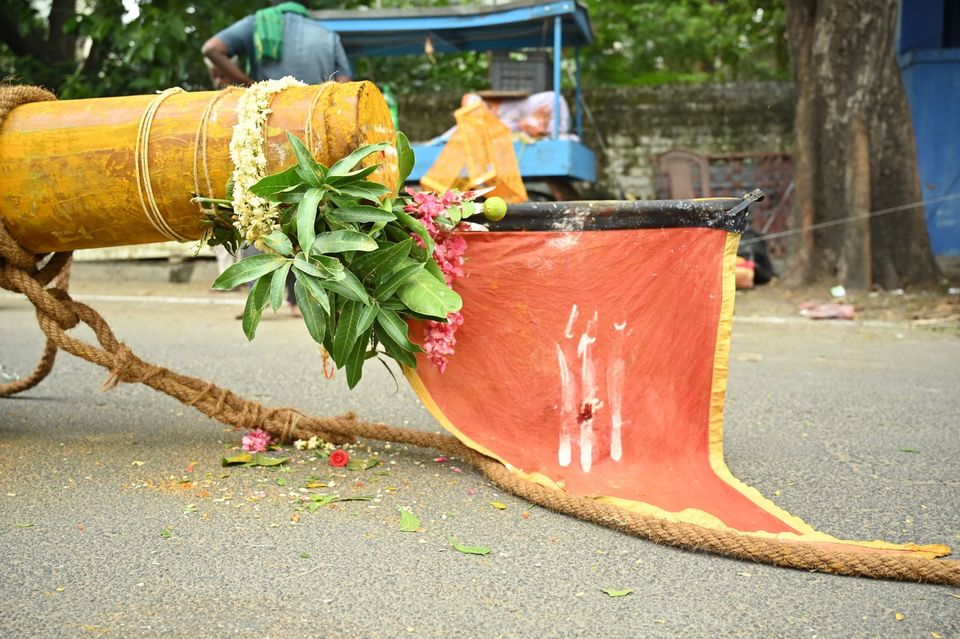
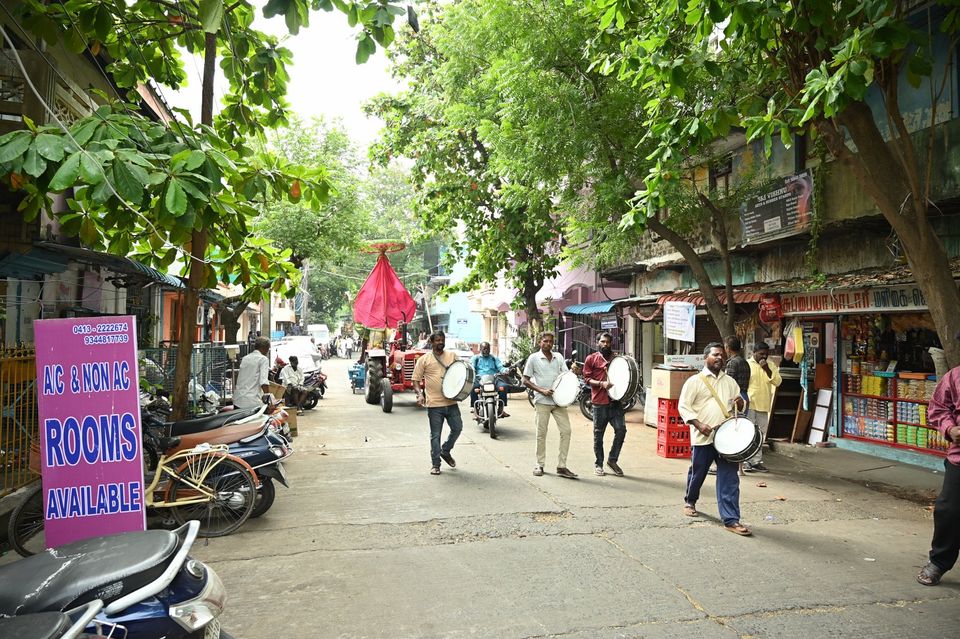
Once inside, we got to see that all the dhvajarohanam rituals had been completed in the pretty small area to the left of the kodi maram, with people in queue allowed to stand on the other side of it. We walked in to the bali peethams being given their customary, preemptory, obligatory feedings. After this began the bhakta-driven part of the day, with people bringing flowers, archanai offerings, and specifically green (Pachai Mani Malai) and black beaded malas to be placed at the feet of the deity and then around their necks by the priests. Then the tying of the kaappu for several – men and women, those associated with this specific temple utsavam and not, it seemed. Then of course the purappadu, which becomes Ghousiga’s signature event because of the energy, vigour and dance of it all. One of the tavil players said later than his fingers were broken (they discussed salves) and that the dance was “over” (over the top) these 6 days, and would be about half this in the days after Sashti. The purappadu “route” is one circle in the inner prakaram, stopping at the main shrine for blessings, then out and to Thulasi Mariamman, and then the dance – and then down Bharati–Nehru–MG road all the way back to the railway station road. Apparently the day the chariot gets pulled, it goes all the way to Thyagaraja street, making the whole area within the boulevard effectively this temple’s maada veethi.

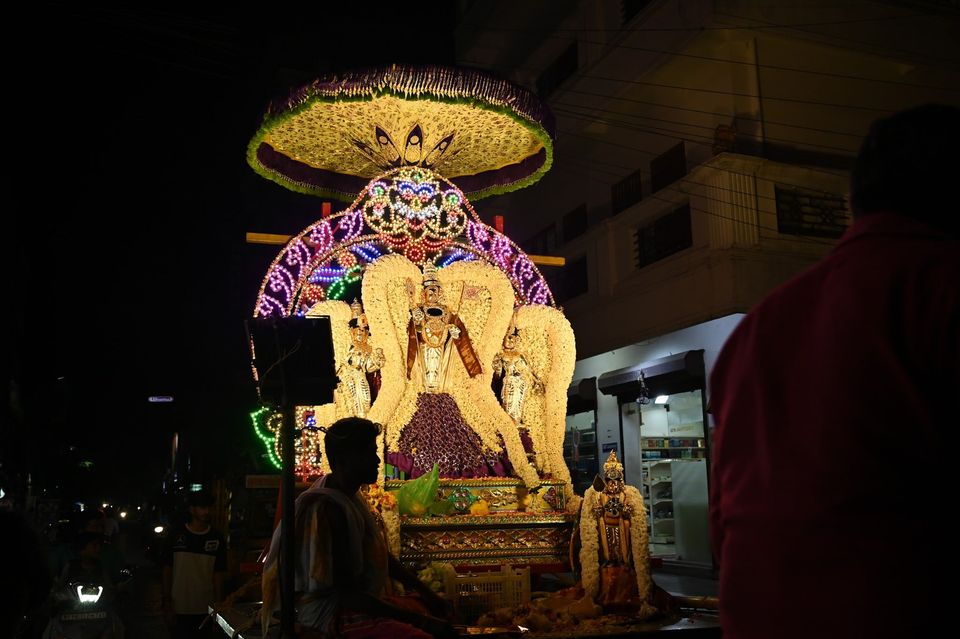
Interspersed with all the dance was the interaction with this swinging hanging angel that had a cup full of flowers and was swung in a way that would, eventually, release all the flowers at its apogee, onto Murugan himself (who was by the way looking very grand on the chandra prabhai, though he was almost sitting on the crescent moon rather than being framed by it). All phones were out to capture this – and handles like @yen_pondy acting like advertising agents for Ghousiga rather than the reporters they’re technically supposed to be (they barely ever post on Lawspet, for example, but Ghousiga got major previews many days ahead–clearly they were impressed). A bit gimmicky maybe, but certainly a crowd pleaser to see everyone’s beloved Murugan being so feted.
More from Ghousiga Balasubramaniya Koyil

Ghousiga Balasubramaniya Koyil · Kanda Sashti Vizha Day 8Ghousigabala Murugan · Kanda Sashti Vizha Day 8

Back to Lonely Nights and Long Trails

“The dancing after sashti will be 50% reduced,” one of the nadaswaram players had once remarked. We missed the send-off from Ghousiga, but found Murugan with Vinayaka and Veerabahu on Bharati street about to come into the market area. Were there nadaswaram players leading the way? Somehow neither of us could recall hearing their heralding sounds. The little red Ghousiga tractor was leading the way. It’s funny, but Ghousiga’s temple crowd seems so entirely different from their madaveethi crowd, comprised of what households remain on their path, what temples are open when they pass, and all the market women who don’t look like those we’ve ever seen at the temple itself, but who stop the procession unfailingly and offer Rs 10, Rs 20, whatever they pull out of their sari knots doubling as money belts. This isn’t the Insta crew. The young priest who helps out recognised us and gave us extra flowers. He’d also been the one to tell us that the deity who comes out in the mornings is the pradhana murti who was there from the beginning. The evening purappadu takes out the samhara murti, only recently acquired.

Read more
Ghousiga Balasubramaniya Koyil, Nandhikeswara Koyil, Sundara Vinayaka Koyil · Kanda Sashti Vizha Day 7Ghousigabala Murugan, Nandhikeswara, Sundara Vinayaka · Kanda Sashti Vizha Day 7

Three Family Weddings in a Single Morning

The day after sashti is the day for the Murugan Thirukalyanam, because after the defeat of Soorapadman, Indra regains his kingdom. In gratitude, he offers his daughter Deivayanai (Devasena) in marriage to Murugan. We’re not sure why the Valli Kalyanam happens on this day, and speculate that the Murugan Thirukalyanam that also takes place at Panguni Utthiram is when that second wedding celebration happens. But we’re going to have to wait and see if that’s in fact the case. In the meantime, Valli isn’t excluded from today’s event. Murugan may be wedding Deivayanai, but he’s also wedded to Valli. Three weddings happen this morning, at three temples, all in the hours between 9am and 11am. We find ourselves darting between Sundara Vinayaka, where Rami mam’s sister is the sponsor, and there’s the usual gathering of ladies there though a priest has been called in to do the homam and perform the nuptials. On one of our dartings, we find the women about to recite the whole of the Kanda Sashti Kavacham, which in a chorus sounds rather good. The temple has a mic set up, and speakers to broadcast beyond its four walls. Nandhikeswara’s published schedule is below. Here, too, we dart in and out, but spend most time here as it’s just always a nice place to be. 7:00 AM: Maha Abhishekam (sacred bath) will be performed for Sri Gnana Velayudha Swami, accompanied by his consorts Sri Valli and Sri Devasena. 9:30 AM and 11:30 AM—during the Thiruvonam star and Thula Lagna—the divine wedding ceremon

Read more
Lawspet Murugan Koyil, Ghousiga Balasubramaniya Koyil, Chetty Koyil, Vedapuriswara Koyil, Angalamman Koyil · Kanda Sashti Vizha Day 6: SashtiLawspet Murugan, Ghousigabala Murugan, Chetty Koyil, Vedapuriswara, Angalamman Muthialpet · Kanda Sashti Vizha Day 6: Sashti

The Greatest Battle of Them All: Soora Samharam

Many temples mark today in some form. Angalamman Koyil does a Murugan Abhishekam and maha deeparadhanai in the morning. Vedapuriswara, anticipating this day, does a 7am-5pm 36-time recitation of the Kanda Sashti Kavacham, on top of the daily 7am Balamurugan abhishekam, and later Murugan abhishekam, evening parayanam. We saw the arrangements made outside the Chetty Koyil for the samharam, and the bells still ringing at 11pm as we passed by en route to Ghousiga, but we have no images of these events. Our morning was spent watching the procession at Lawspet and the raising of the kodi that was the spine of Vajrabahu, on which the Navaveerangal would climb later in the evening to sing songs of Murugan, Siva, and Amman (Parashakti). For being the gigantic spine of an asura, this structure was treated with significant reverences. Turmeric was applied, vibhuti and kunkumam, flowers. A small bell at the head represented Vajrabahu’s skull. Flowers. I was told to be careful not to step on the ropes that would be used by the waiting crane to haul this into position. This sort of reverence had either got to be purification –or acknowledgement of Vajrabahu’s having now become one with Murugan. A smaller wooden piece was first placed in a waiting hole in the road (the hole must always be there, just closed up the rest of the year and opened again for the festival) – the hole was anointed of course, by Sriram Gurukkal, with turmeric water, milk, chandanam and the like. Then the short pole p

Read more
Lawspet Murugan Koyil, Ghousiga Balasubramaniya Koyil, Nandhikeswara Koyil · Kanda Sashti Vizha Day 5: PanchamiLawspet Murugan, Ghousigabala Murugan, Nandhikeswara · Kanda Sashti Vizha Day 5: Panchami

The Battle Continues and Murugan Gets the Vel

Crowds are slowly gathering as the festival tends towards Sashti. Though the day proceeds through some now familiar motions – abhishekam for moolavar and utsavars in temple, abhishekam for the Navaveerangal, the vel’s pradakshinam, the movement of the decorated utsava murtis outside to be seated on the vahanas, their procession through the madaveethi with so many houses alive and ready to meet them enroute. They arrive on the main road near the small vinayaka shrine that was perhaps once on the side of the road, but now finds itself in the middle. No matter, one side of the road is set up with keeth roofing at two ends – the Sooran Kottai as it’s called on one end, and the place near the temple for Murugan and the Veerangal on the other. I walk and talk with Siva enroute. He makes many interesting observations about how their group has built this temple’s traditions, or kept them going at any rate, starting from the time of the last Kumbhabhishekam in 2018. Prior to that, there was only Veerabahu as an utsavar, no moola murtis, and none of the other utsavar figures. Now their group of about 15, all of them from the area, many working elsewhere, return every year for this festival – they take care of navaveerangal abhishekam twice daily, and all matters involving the purappadu as well as the ritual enactments that happen. Siva doesn’t speak of a continuous lineage easily handed down, but one which they have had to wrest and claim as their own. Parents had other priorities, fin

Read more
Lawspet Murugan Koyil, Ghousiga Balasubramaniya Koyil, Nandhikeswara Koyil · Kanda Sashti Vizha Day 4: ChaturthiLawspet Murugan, Ghousigabala Murugan, Nandhikeswara · Kanda Sashti Vizha Day 4: Chaturthi

May the Battles Begin!

Yanaimukha Samharam at Lawspet. Our morning begins at the Yaga Sala where a new Veerabahu member, perhaps coming from afar and unable to join from day one, gets his yajnopavitam and kaappu. He then joins his brothers outside the Navaveerargal shrine from where they proceed on their routine Vel procession. Not needing to document this recurring procession once more, we drift towards the purappadu-ready deities sitting outside their alankara mandapam. The deities are the same processional ones – Vinayaka, Veerabahu and his brothers, and Murugan with Valli-Devasena. Also tentatively part of the formation is the astra murti no taller than a foot. Its Murugan is no taller than half a foot, and his two consorts are at most one-third. This astra murti only oversees the twice-daily bali offering. We also observe the serpentine form that adorns Vinayaka’s arching thiruvachi – two serpentine bodies beginning from either ends of the arch, joined by a single serpent head above and behind Vinayaka’s. We are uncertain whether it is indeed a serpent or mere adornment that suggests and invokes that resemblance – both of which find resonance with our earlier exploration of the Pavitrotsavam. The procession deities are soon lifted, taken around the prakara, venerated at the Yaga Sala where the concluding purnahuti is performed, and are brought out with a Gopura Darshanam to face Yanaimukhasooran who waits tall outside. The sooran is elephant-headed with four tusks capped with golden embellishm

Read more
See all field notes →