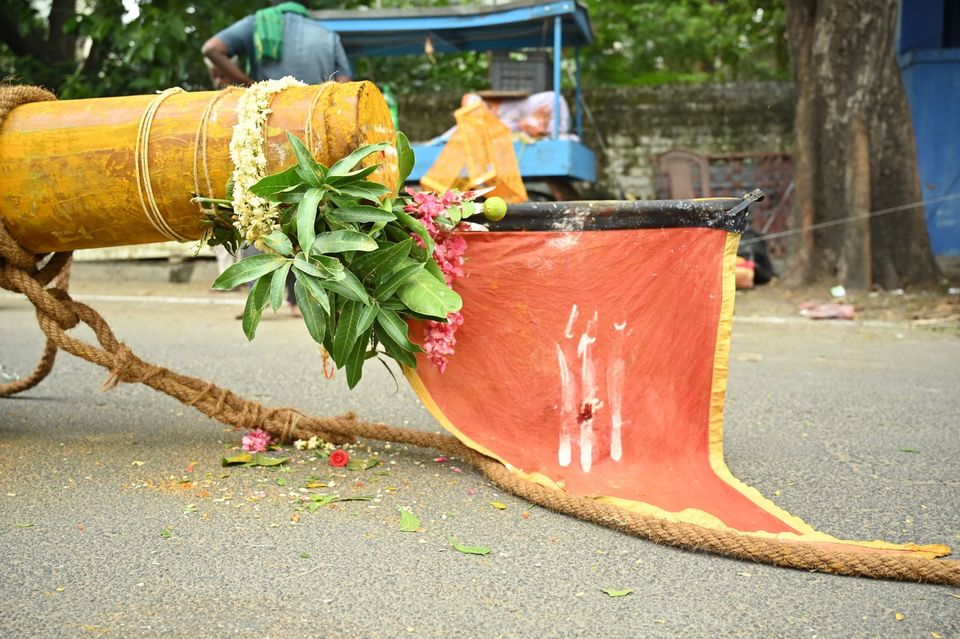
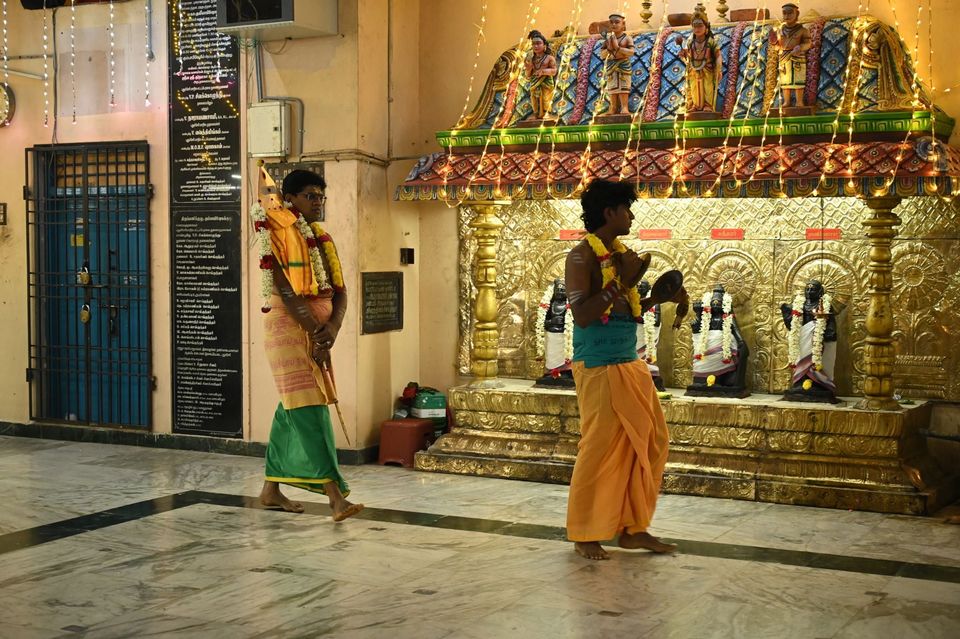
Crowds are slowly gathering as the festival tends towards Sashti. Though the day proceeds through some now familiar motions – abhishekam for moolavar and utsavars in temple, abhishekam for the Navaveerangal, the vel’s pradakshinam, the movement of the decorated utsava murtis outside to be seated on the vahanas, their procession through the madaveethi with so many houses alive and ready to meet them enroute. They arrive on the main road near the small vinayaka shrine that was perhaps once on the side of the road, but now finds itself in the middle. No matter, one side of the road is set up with keeth roofing at two ends – the Sooran Kottai as it’s called on one end, and the place near the temple for Murugan and the Veerangal on the other.
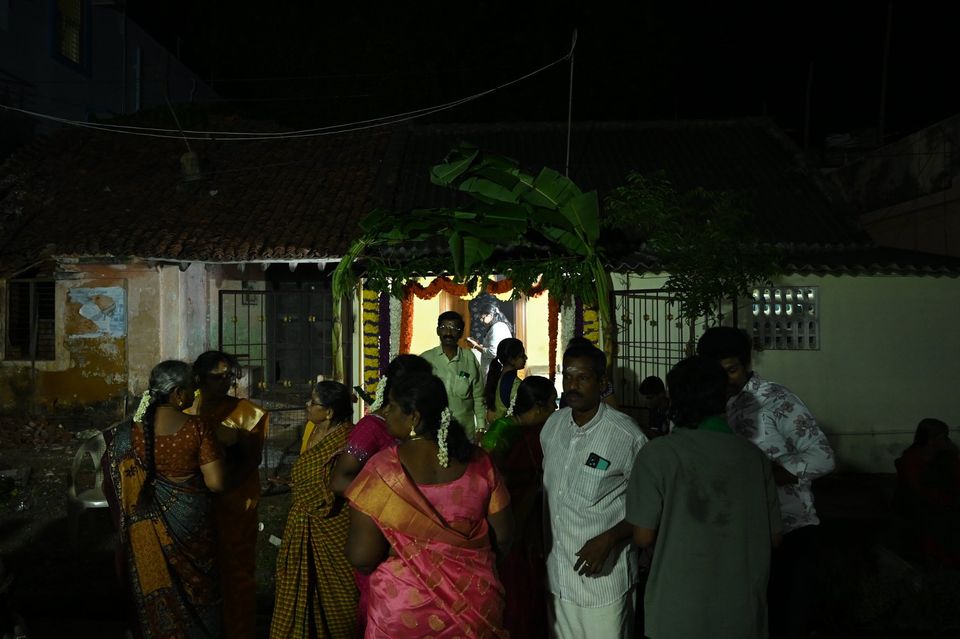
I walk and talk with Siva enroute. He makes many interesting observations about how their group has built this temple’s traditions, or kept them going at any rate, starting from the time of the last Kumbhabhishekam in 2018. Prior to that, there was only Veerabahu as an utsavar, no moola murtis, and none of the other utsavar figures. Now their group of about 15, all of them from the area, many working elsewhere, return every year for this festival – they take care of navaveerangal abhishekam twice daily, and all matters involving the purappadu as well as the ritual enactments that happen. Siva doesn’t speak of a continuous lineage easily handed down, but one which they have had to wrest and claim as their own. Parents had other priorities, financial futures to secure (his family has a shop in the big market just inside the entrance across from Singapore steel, he said, 4th one as you enter) and so many “restrictions,” not the “liberations” that they could then bestow on the next generation. Generational transfer, as it turns out, may in these ways skip a generation. Not all elders were secure about handing over their traditional vocations to a younger group they feared may take with them their own livelihoods. The family that used to enact the asuras roles had no takers. So they had to hire and train new actors, ensuring new lineages and new commitments. I asked about the script they were following, how that has transferred from oral to written tradition–he spoke of it as an accrual of material from multiple sources, painstakingly written down and now practiced, enacted. Still more songs need to be recorded, he said. And it occurred to me then that a lot of us are doing this work of defragmentation – collecting the potshards from cupboards and dumps as it were, piecing them together, bringing them back to life.
Siva spoke also of murungai maram because there are many enroute and how you could tell a Mudaliar neighbourhood by the number of murungai trees in the area – it is the source of endless variety (poriyal, saar, koottu, more) from a single tree. These were trees so abundant nobody needed to buy from the market. Now, that’s different, and many of us do.
Today’s battle is with three of Soorapadman’s sons: Banugopan, Vajrabahu, and Agnimukha. Both Banugopan and Agnimukha are sons by Padmakomalai, herself the daughter of the asura architect Maya (and therefore Mayai herself), and associated with the fiery aspects of the sun: Banu+Kopan; the name is associated with an episode from his childhood in which he challenged the Sun, having been given Suryan as a plaything. Vajrabahu’s antecedents are less immediately clear (they may be part of this temple’s own retelling of Tamil Kanda Purana episodes), but he and Veerabahu make mutually challenging vows: the victor will make a ladder of the spine of Him whom he defeats, and climb it to sing the praises of Murugan (or Soorapadman, but we know it will be Murugan).
Once Banugopan and Vajrabahu are defeated, Agnimukha performs a homam to invoke Kali, who is conjured and arrives–but sees her own son Murugan in the battle and refuses to act opposite to him. This is all ritually recreated with fire on the streets. We wonder at some point why the parai-vadyakaras (men with the parai drums) disappear, but they reappear at the other end of the street with a blue, 10-armed, hair flying Kali figure. It’s time now for pyrotechnics. Kali dances in fire. She blows it, she is encircled by it, she emerges from it, she creates it, she eats it. Move, her hands gesture with surprising gentleness, when the fire lit from poured kerosene threatens to come our way. She’s given a poosani – ashgourd, on which she steps and into which she thrusts her trident (the ashgourd is often used like limes, to ward of dhristi, perhaps owing to its head-like form). She is given a bowl of red liquid; she drinks, she spits, she spews. Slowly she moves towards Murugan, carrying a clay neruppu vessel as the Thirunangais do during the Angalamman Mayana Kollai event. And once she sees her son there, She retreats and disappears.
All this sounds very dramatic and fearsome, but the 9 veerangal going up and down with their paper scripts, speaking to the caricatured Sooran character (all the ill-fated brothers played by a single man, who can be found locally if you ask for “sooran veedu” or Sooran’s house in the neighbourhood) – all this is quite comical, as is some of the dialogue shooting back and forth. I’m tired, says the Sooran, I’m hungry, let’s finish this fast, what are you a small child threatening someone like me? The call-and-repeat patterns of dramatic conversation make for amusing listening. Entertainment, after all.
Each day after the day’s asura quota has been vanquished (acted by the group of braves coming forward with the Vel, backed by Murugan and the Sooran’s head covered with a cloth), the Vel receives a cooling abhishekam, aradhanai, and the procession returns to the temple.
In the evening, is the Vel Vanguthal
Or, when Murugan receives the spear from his mother, Parvati, Parashakti.
In this telling of the Skanda story, Gajamukha is Tarakasura, brother to Simhamukha and Soorapadman who is the oldest and must be vanquished. Kashyapa and Maya unite in the form of elephants, simhas, goats (producing the daughter who is Ajamukhi). The first, handsome without equal, was Soorapadman. 3-2-1, goes the tale, so Tarakasura goes first, then Simhamukha, then Soorapadman himself. Ajamukhi makes cameo appearance as the goat that Murugan rides – this evening, as it turns out, after the vel vanguthal.
We heard a great deal about Sikkal from many who were around: சிக்கலில் வேல் வாங்கி, திருச்செந்தூரில் சம்ஹாரம்/ Sikkalil Vel vaangi, Tiruchenduril Samharam/ "Receiving the Vel at Sikkal, and performing the Samharam at Tiruchendur." The recreation of these events in Pondicherry then places us in this lineage of Sikkal and Thiruchendur.
Now, during the Vel Vaangum Utsavam, immediately after receiving the Vel, the bronze utsava murti of Singaravelar is said to develop beads of perspiration on face and body. The sweat is wiped off, but devotees report that it reappears. The phenomenon is traditionally understood as an expression of Murugan's Veeravesham – his intense warrior disposition as he prepares to go into battle against Soorapadman.
But this gives rise to what can only be described as competitive sweating. The Times of India’s Samayam in 2019 reported the Ghousiga murti sweating. Another report in 2024 reported the Saram Murugan sweating. I guess these reports do their rounds, as temples vie for trending miracles and crowd draws.
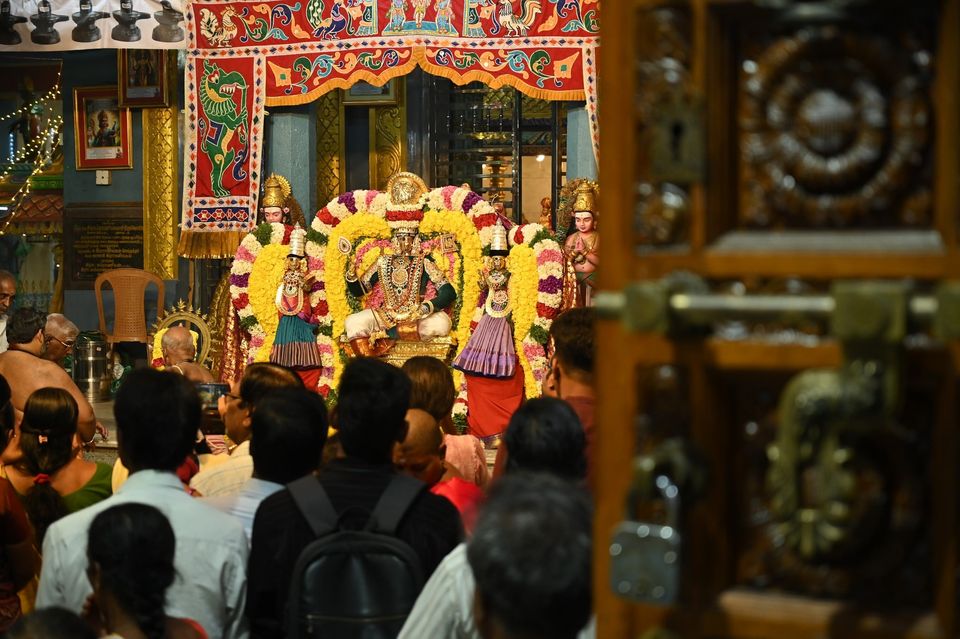
Lawspet Murugan seems (as of now) free of perspiration. The yagasala puja seems to happen in fits and starts. We try to record it, but then a dance (with an invited Malayalee group) begins, and the sound is much too loud to make any recording worthwhile. Screens are set up all around, showing the temple in situ. Soon, there is a crowd in the temple so dense it’s hard to believe there are that many who live in the area. The lights go out at one point, and the whole area is lit only by the lamplight from Parvati’s garbhagriha. It’s surreal but it doesn’t last as people quickly whip out phones and the lights come back on. A “corridor” from the Parvati shrine (she’s done up with chandana kaappu) to the end of the temple prakaram is clear, with the area at the top of the 3 stairs reserved for the nadaswaram and tavil players who do a concert at the Priest Sriram Gurukkal’s direction. He specifies ragas, they play–in a manner similar to performances at the dhvajarohana. He announces recitations of the veda, and the scholars present chant. A woman goes into some sort of trance, and it’s regarded as entirely normal for that to have happened. All this happens after a maha deeparadhanai, which is a spectacle to behold.
Our Navaveerangal group are holding up Murugan, in a standing alankara position, the floral prabhai behind him larger than usual. Siva has the Sengol. The spear is held by the same elderly man who keeps it all through. The elder priest and younger, the Gurukkal and his son, get the parivattam. Men are made to stand with baskets of flower petals as the elder priest moves to get the vel, and when he does, he is supported by his son. It is a moment of intense drama. Flower petals fly, the vel shakes, the priests must control it but they can only barely, and it is in limbo until it comes into Murugan’s waiting hands. The exhausted priest is carried away–he will be mobbed later for the vibhuti he will have in his hands, from the moolasthanam
Meanwhile Murugan, vel in hand, comes to the yagasala and then proceeds to move out for the evening’s purappadu – on a vahana that is the goat, representing (presumably the control of) the only child of the handsome Sooran not yet slain, his daughter Ajamukhi.
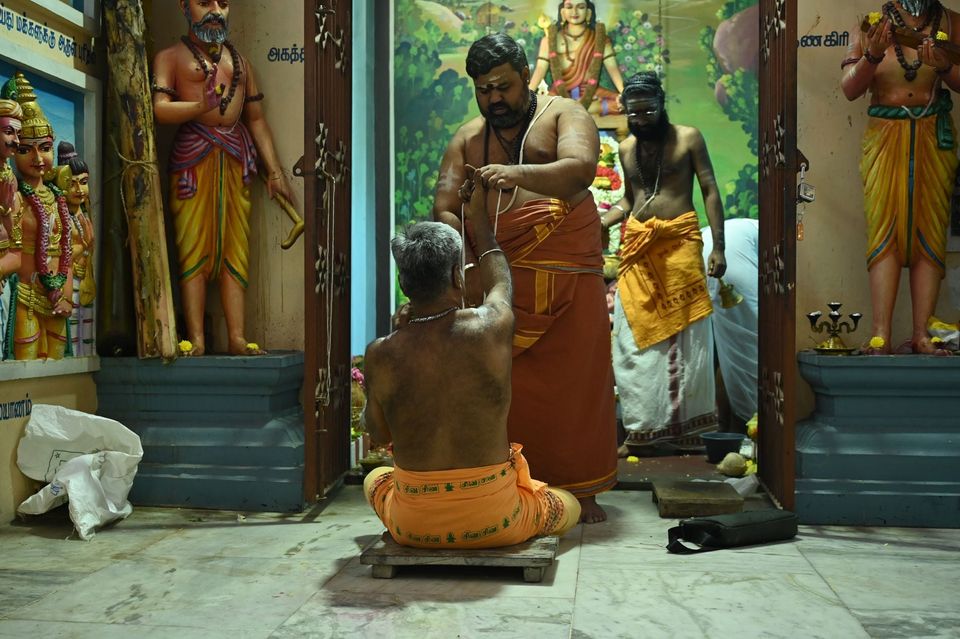
Nandhikeswara: we didn’t make it here today, and have the photos included here courtesy of Dewan Kandappa.