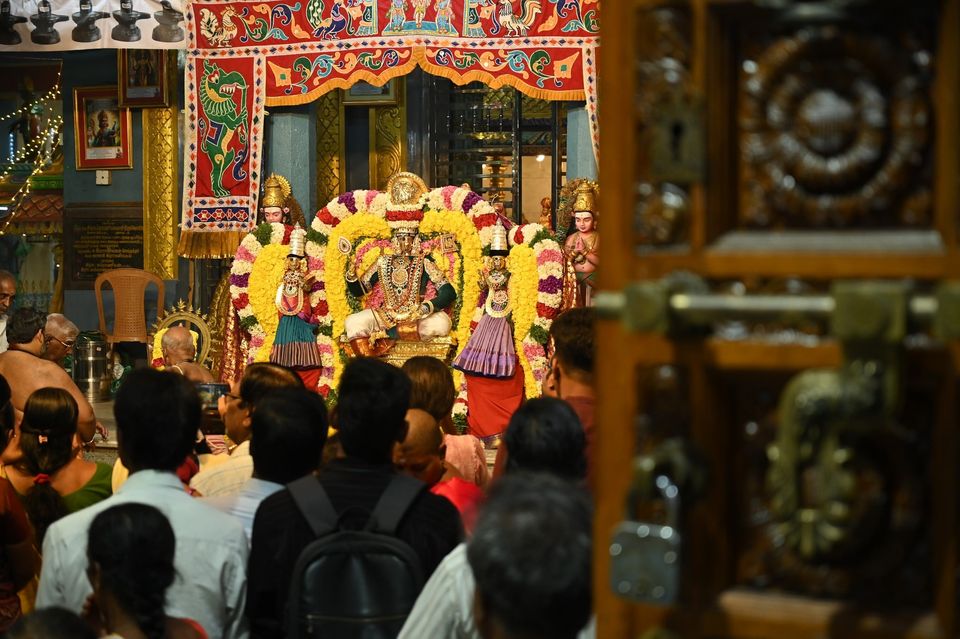
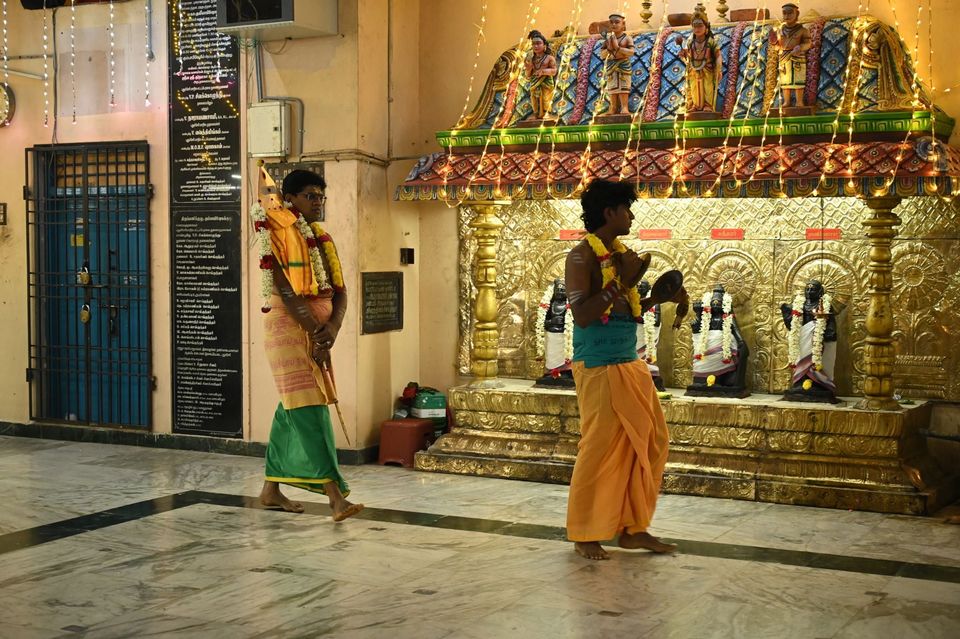
Yanaimukha Samharam at Lawspet. Our morning begins at the Yaga Sala where a new Veerabahu member, perhaps coming from afar and unable to join from day one, gets his yajnopavitam and kaappu. He then joins his brothers outside the Navaveerargal shrine from where they proceed on their routine Vel procession. Not needing to document this recurring procession once more, we drift towards the purappadu-ready deities sitting outside their alankara mandapam. The deities are the same processional ones – Vinayaka, Veerabahu and his brothers, and Murugan with Valli-Devasena. Also tentatively part of the formation is the astra murti no taller than a foot. Its Murugan is no taller than half a foot, and his two consorts are at most one-third. This astra murti only oversees the twice-daily bali offering. We also observe the serpentine form that adorns Vinayaka’s arching thiruvachi – two serpentine bodies beginning from either ends of the arch, joined by a single serpent head above and behind Vinayaka’s. We are uncertain whether it is indeed a serpent or mere adornment that suggests and invokes that resemblance – both of which find resonance with our earlier exploration of the Pavitrotsavam. The procession deities are soon lifted, taken around the prakara, venerated at the Yaga Sala where the concluding purnahuti is performed, and are brought out with a Gopura Darshanam to face Yanaimukhasooran who waits tall outside. The sooran is elephant-headed with four tusks capped with golden embellishments, and with four arms wielding only weapons: a mace, an axe, a sword and a shield. His torso is decked in jewels, and his trunk and forehead sport the Tripundram.
As Murugan, the Navaveerargal and the Samhara Vel take their places braving the sooran, a distant drumming is heard from behind that large body. Looking ahead we see a small troop consisting of 3 drummers, a few helpers, and two figures dressed and crowned in black with faces painted pink and red respectively. “They are the actors of the soorans”, we were told yesterday by Siva of the Veerabahu group. He also told us that the enactment of the Samharam has always been done by the Senguntha Mudaliars, whose origin traces back to the Navaveerargal. The soorans also were played by hereditary families of this sect, so much so that they were referred not by name but by ‘sooranveedu kaaran’ or ‘of the sooran house’. “But they have been unable to sustain it, so we have had to train actors from outside for this”, continues Siva. Very much like the soorans of Vallala Kottai at Angalamman and Mahisharooran of Nagamutthu Amman, they are dressed in black skirts and large black rooster-feathered crowns, with shirts and pants as close to black as possible. They are decked with thick heavy jewellery-like embellishments that are studded with mirrors, both on their chests and their shoulders, with the latter resembling small wings.
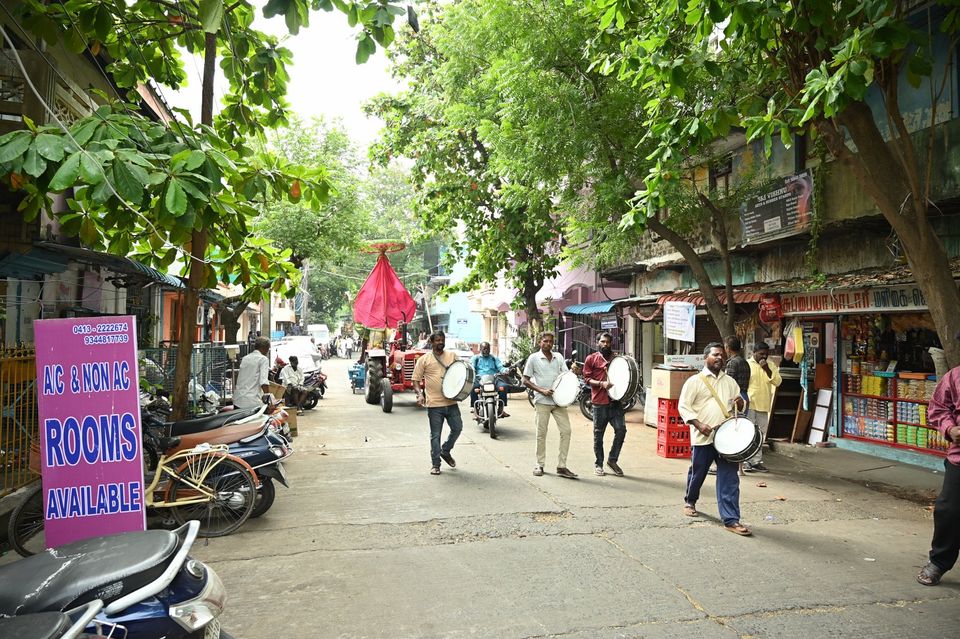
They march forward, past Yanaimukhasooran, past the Veerabahus, past the Samhara Vel, past Murugan, and straight into the temple to pray to Vinayaka. The sight is a living expression of the divine Leela. The Soorans are the opposing principles who, by seeking Vinayaka’s blessings, acknowledge their necessary role in the play to be divinely guided and ordained. This is followed by a brief swirling dance around the temple prakara, before heading out and taking their place at the feet of the Sooran murti. Perhaps it is fair to say that the pink-faced sooran represents Yanaimukhasooran who was iconographically present in the murti as well, and the red-faced sooran represented Soorapadman, eldest of the brothers and from whom they all draw their strength and pride. A kalasa is brought out presumably from the Yaga Sala and kept before the Sooran-triplet. A final few archanais aradhanais are offered to this kalasam, the water from which is then sprinkled over the soorans and the people. It would be revealing to know what deity is invoked into this kalasam that blesses the soorans. The procession then departs on its hour-long pradakshina through the Mudaliar streets after which it arrives at the Lawspet Main Road for the final showdown.
Murugan, the Navaveerargal and the Samhara Vel take their place by the Vinayaka temple on the middle of the road, and Yanaimukhasooran opposite to them some 70 meters away. So the battle begins. The Veerabahu members wielding vels and bows & arrows play the Navaveeras, and the lone pink-faced sooran plays Yanaimukhasooran wielding a comically little sword. There ensues a long animated verbal back and forth with both groups pressing ahead and retreating with the undulating dynamics at play. The dialogue tries to follow a script, but a spontaneous light-hearted chaos comes over and the sooran’s comical pokes and jibes send ripples of laughter among the watching crowd. The Veerabahus too cannot help but smile in the midst of their battle. They go back and forth multiple times, with a few particularly dramatic pushes from the sooran, answering which the Samhara Vel dramatically presses forward and blows some vibhuti upon the possibly wounded Veerabahus.
Finally, upon the Veerabahus’ dire need for help, Murugan rolls forward and in a very fleeting moment slays Yanaimukhasooran and returns. The brief moment is made to feel very charged and potent by all the movement and clamour around it. A cloth quickly wraps the yanai mukham signalling his Samharam, and a Vel abhishekam immediately begins back at the Murugan-end of the road-stage to pacify the charged Spear. The Veerabahus take turns to pour the milk, and this concludes the first of the three Samharams.
Nandhikeswara alankaram today: He’s with a veena, once again. See yesterday’s field note for more on this.
Ghousiga has its Samharam at night. We got there a little past 8, and in usual Ghousiga fashion there was a grand reception for Murugan inside the temple. The crowd is already beginning to grow in anticipation of the final Soorasamharam day, and entry into the temple during the festival hours is restricted. We have already seen the rounds of blessings and singings and dancings from inside, so we stay out this time. After his final dance in front of the makeshift Yaga Sala, Murugan steps down and out of the temple, though still kept from view by a temporary foldable gate that acts as a thirai. The often enormous crown/giridam of flowers resting on Murugan’s head peeks out above this gate, and one can see it steadily swaying awaiting the grand opening. The kudai is raised behind Him, and the gate swings open with a rapid crescendo of the thavil and nadaswaram.
A brief visit to the Thulasi Mariamman shrine is followed once again with dance-dance-dance of the deity and swing-swing-swing of the flower-tossing angel. This goes on for well over half-an-hour and at around 9pm Murugan emerges out to the road where Gajamukhasooran has been waiting all day. Just as we think we are about to see the Samharam, Murugan pivots the other way and marches on leaving the sooran confused and behind! Turns out that Murugan walks around through Latouche street and comes back to the Morisson street side of the temple to climb his vahana – today the silver Adhikara Nandi. Meanwhile, Gajamukhasooran is also wheeled onto Morisson street and aligned to brave Murugan. It is interesting to note that Vinayaka and Veerabahu, who are otherwise present for every purappadu, were not here today. Perhaps due to a lack of space since Adhikara Nandi vahana was entirely on shoulders? There was a brief pause after these to bring out the Vel. We could not see inside the temple due to the crowds, but horns and drums of the Kailaya Vadyam were certainly declaring some significant movement within. Soon the Vel emerged with its head sailing over peoples’. It was held by the elderly priest who seemed to have lost consciousness at the touch of the Spear, supported by Khadir Sir who held the priest with one hand and the Vel with the other. They went first to Gajamukhasooran, then into the hand of Murugan. A curtain was raised over the entire scene, and dropped, revealing a deeparadhanai – and so the Samharam began. The young priest Rajesh lead the way with the deepam of the archanai-thattu raised, and Khadir Sir and the elderly priest followed again with the Vel – the priest seeming in more agony at the touch of the Spear. They marched ahead nonetheless, and again as with Lawspet, one brief moment was all it took for Murugan to slay the sooran over whose face cloth instantly fell. The charged Vel was immediately brought back to the feet of Murugan where an abhishekam followed. It was touching to see Khadir Sir and his son Farhaan hold the Vel during this pacifying bath–now their claimed lineage and their tradition.
Deepa’s old friend and colleague from UT-Arlington, Ritu Khanduri’s daughter Vidula was in town and pulled along for both today’s rides. She got a real taste of what big tamasha temple vizhas can be like! But as a daughter of an anthropologist, she’s already been in the thick of things and is a dyed-in-wool pro!