The day after sashti is the day for the Murugan Thirukalyanam, because after the defeat of Soorapadman, Indra regains his kingdom. In gratitude, he offers his daughter Deivayanai (Devasena) in marriage to Murugan. We’re not sure why the Valli Kalyanam happens on this day, and speculate that the Murugan Thirukalyanam that also takes place at Panguni Utthiram is when that second wedding celebration happens. But we’re going to have to wait and see if that’s in fact the case. In the meantime, Valli isn’t excluded from today’s event. Murugan may be wedding Deivayanai, but he’s also wedded to Valli.
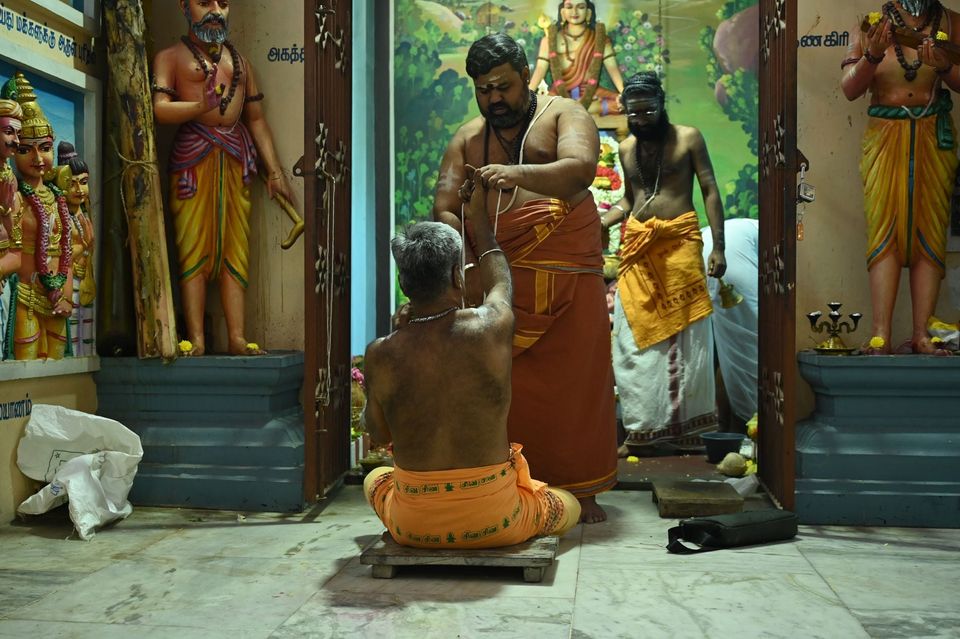
Three weddings happen this morning, at three temples, all in the hours between 9am and 11am. We find ourselves darting between Sundara Vinayaka, where Rami mam’s sister is the sponsor, and there’s the usual gathering of ladies there though a priest has been called in to do the homam and perform the nuptials. On one of our dartings, we find the women about to recite the whole of the Kanda Sashti Kavacham, which in a chorus sounds rather good. The temple has a mic set up, and speakers to broadcast beyond its four walls.
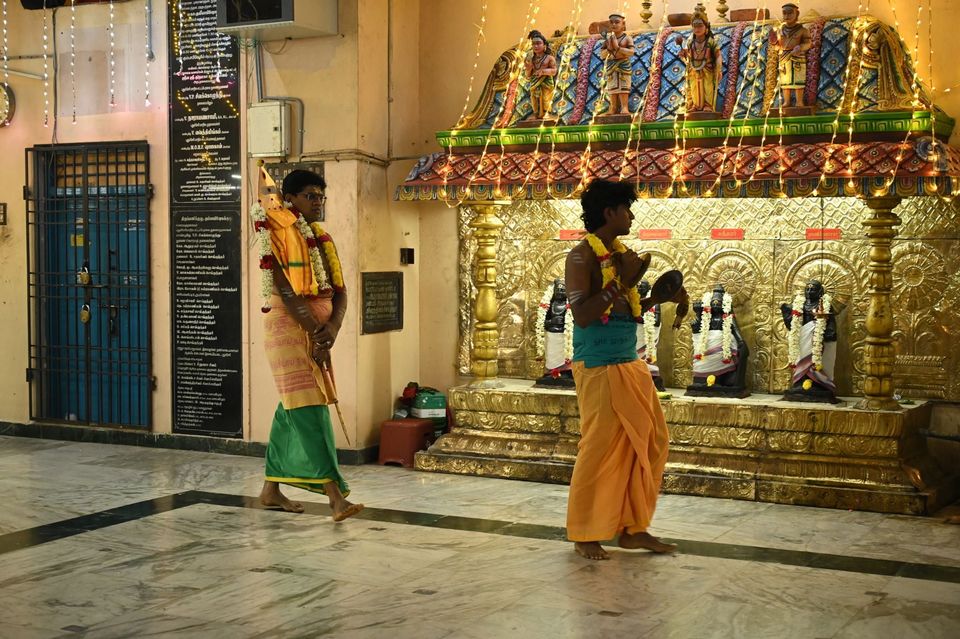
Nandhikeswara’s published schedule is below. Here, too, we dart in and out, but spend most time here as it’s just always a nice place to be.
7:00 AM: Maha Abhishekam (sacred bath) will be performed for Sri Gnana Velayudha Swami, accompanied by his consorts Sri Valli and Sri Devasena.
9:30 AM and 11:30 AM—during the Thiruvonam star and Thula Lagna—the divine wedding ceremony of Sri Gnana Velayudha Swami (with Sri Valli and Sri Devasena)—who resides and bestows his grace at the temple of Sri Nandi Emperuman—will take place.
Wedding Ceremony Schedule:
9:30 AM – Seeking the blessings (Anukkai) of Sri Gangai Vinayaka, followed by a ceremonial procession with offerings (Varisai Thattu) to the Yagasala (sacrificial hall, which is set up in the maha mandapa facing east).
10:00 AM – Thiruvilakku (lamp) worship, Varuna Kalasa puja, Maha Sankalpam (solemn vow/intention), and the chanting of the Kandar Kalivenba (from the Thirumurai scriptures).
This will be followed by the tying of the Mangala Naan (sacred wedding necklace) upon Sri Valli and Sri Devasena, along with Maha Shodasha Raja Upacharas (sixteen grand royal offerings), the recitation of Pancha Puranam and Thiruppugazh, and hymns of praise.
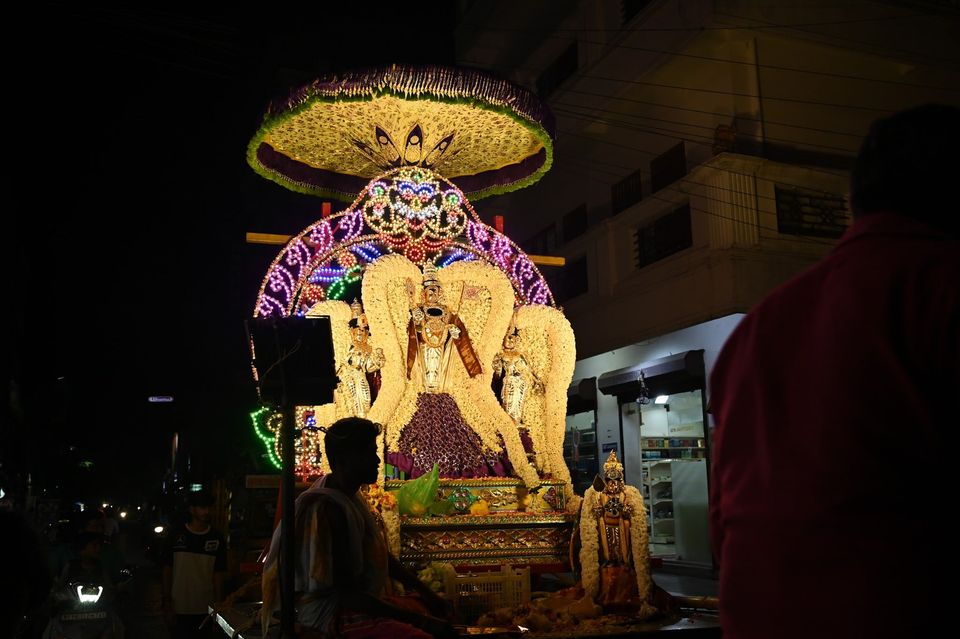
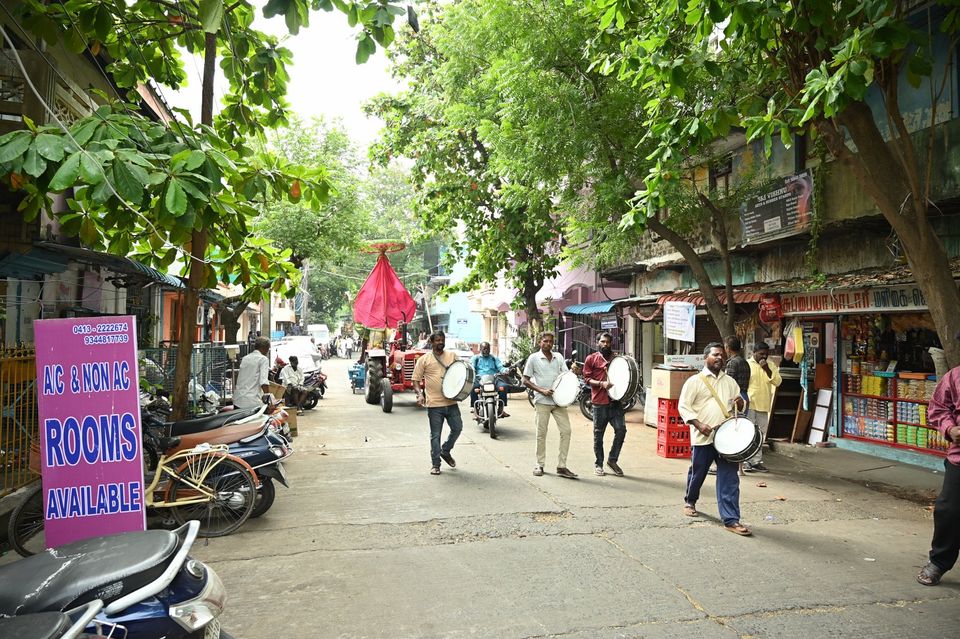
Ghousiga Balasubramania Swami’s Thirukalyanam of course was the biggest affair of the morning. A stage had been set up blocking the road, and the entire length of road up to the temple entrance was packed with people. Two large groups of women were seated in two large enclosures that had been demarcated, one behind the other, directly in front of the stage. A third enclosure was standing room only. The road was dense with bodies, no way to cut through if you came in from the wrong entrance. The temple itself had a long queue as well. We got there after going to Sundara Vinayaka and Nandhikeswara, and had little hope of any but the most distant views. The wedding itself was just coming to a conclusion anyway, so we got just a few atmospheric photos and left – beat it out of there, more like it. I admire the patience of those who sit and wait long for “swami darshan,” but the endless stream of beautifully dressed women and people from just about all the other temples we know was a little bewildering. There are other Thirukalyanams happening in the area, after all, and some with less hype and more space than Ghousiga–what is pulling everyone here?
Janardhanan (the man who comes to play the drums for Kailaya vadyam, and to carry the deities sometimes) had told us that Ghousiga was “the most trending” place to be. We’ve seen the priests at work and do not doubt either capacity or sincerity, but the place does indeed have a trending party-show atmosphere that gives a whole new sort of meaning to what John Zavos and I, in our introduction to the special issue of the International Journal of Hindu Studies [2009, 13(3): 241-260] once called “show temples.” At the time, we recorded the objection of some folks from the BAPS Swaminarayan Sanstha: “show temples,” they suggested, “implied that the principle purpose of modern temple building was an outward expression of the power of particular organisations; rather, they argued, the building of such temples was an inward-looking act of devotion, part of a broader approach based on selfless service, or seva, which was central to their understanding of themselves as Hindus” (2009: 243). But it’s time now for a rethink on this one. Ghousiga has none of the grandeur or global ambitions of BAPS’ projects. The people there are kind, know their regulars by name and face, are always responsive when approached, and genuinely human in their bearing. But the temple sure does take pains to put on / make space for some mighty big shows, to court social media popularity, and to invite attention. And so a temple with the thinnest “marabinar” (community traditions, heritage) as one of the elderly men in the Lawspet Murugan Koyil put it, could get so popular, the streets were no longer enough to contain its crowds.
So this was a morning of family weddings: all three temples we saw belong to individual families, as it happens. Two were modest, in proportion to size and means. But the hype and hoopla all belonged to Ghousiga.