← Field notes

The Flag Goes Up on Sashti Muthal Naal

Lawspet Murugan KoyilBrahmotsavamKanda SashtiPurappadu

The ubhayakara sankalpam for the day began at 230pm, outside the Siva Siddhi Vinayaka shrine. The opening veneration to he who clears obstacles and enables new realisations did not just end with yesterday’s Vigneswara Puja. It is a pattern that repeats across all the different layers of the Mahotsavam. We observed it in the following abhishekam for Murugan, which only began after there was one for Vinayaka. The bathing of Murugan was a bathing of four – the moola stone deities, the utsava deities, the utsava murti of Siva Shanmukha and the protective astra murti. The abhishekam itself was modest, but the presence of the four Murugans together seemed to invoke an intense concentration of His energy – youthful and victorious.

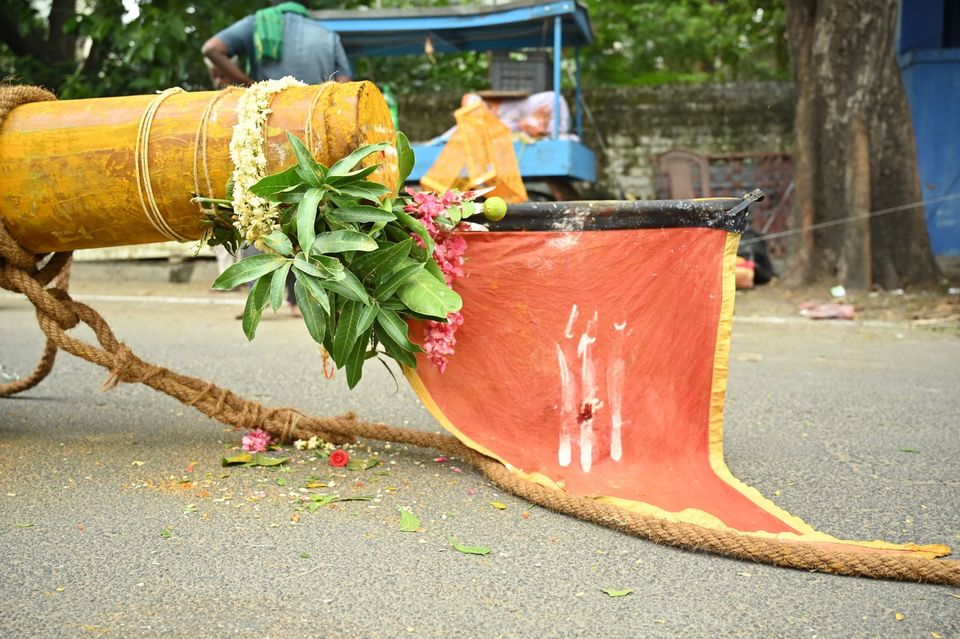
This was followed by the preparation of the flag. It was our first time seeing the flag entirely unfurled, extending comfortably to be over 30ft. The entire stretch of cloth was twisted and rolled, leaving exposed only the very end which had the painting of the Spear, with the Peacock, the Rooster, and a few lamps.

The Navaveerargal shrine at the back was installed during the Kumbhabhishekam 10 years ago. And since then, this shrine’s responsibility during Kanda Sashti has been taken by a group primarily consisting of young men. (Later heard the priest refer to them as the “Veerabahus”, but need to find out more.) This group then proceeded with a very modest abhishekam for the Navaveerargal, all of whose utsava murtis were also brought out and placed in front of their respective moola murtis. The Veerabahu utsava murti is smaller because it existed even prior to the Kumbhabhisheka addition. These Navaveeras are children of the nine Shaktis who were born when nine stones scattered and fell from Parvati’s anklets. Apart from these Navaveeras, the Samhara Vel also is looked after by this group, which is part of the Navaveerargal abhishekam and stands at their centre.

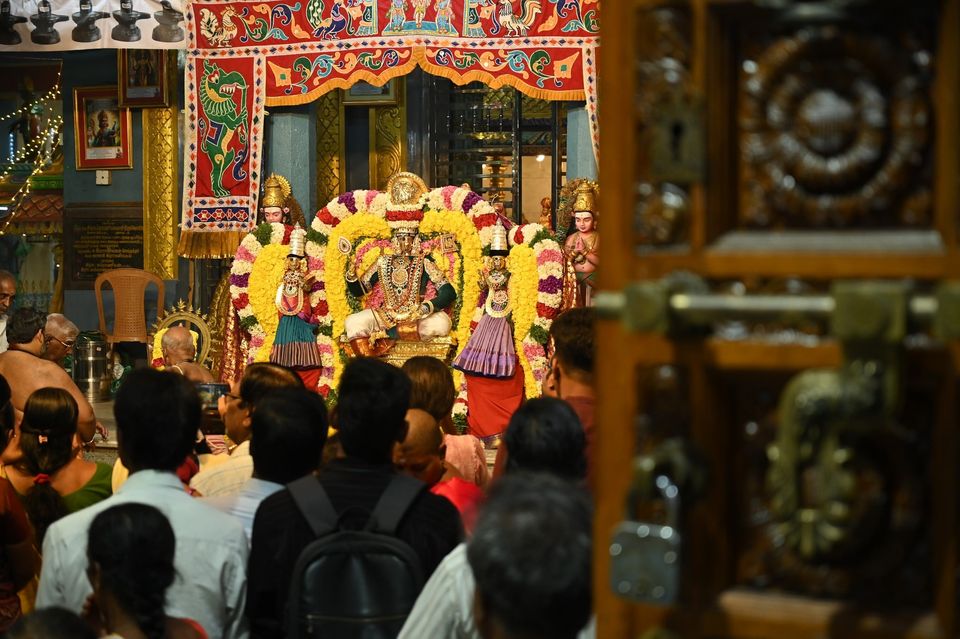
Another hour passes by in preparation and alankaram. By 6pm all the utsavars are adorned and positioned outside the Vinayaka shrine to witness the dhvajarohanam, flag-hoisting. The dhvajastambha abhishekam begins first, with the thronging of devotees all around. The temple gateway is entirely flooded, with many like myself only getting glimpses of the scene from the gopuram stairway. Those unable to watch the dhvajastambha ceremony join the others who flock instead to the Shanmukha utsavar at the back. The lamp-tables are decked with beautiful sestet deepam formations honouring the six-headed one.

Meanwhile, after the dhvajastambha abhishekam, the priests all head to the yagasala, where the head-priest and his son are presented with honourary towels around their heads, and bring back the plate of kaappu sanctified kaappu threads. The flag is given one last pushparchanai, which is followed very interestingly by a small ceremony for the bheri, or thavil, or drum. The drummer too is honoured. The flag is finally raised and tied round the post.

The kaappu threads brought from the yagasala are then tied to Vinayaka, Murugan, Samhara Vel, Navaveerargal, Chandikeswara, the utsava murtis, Murugan’s peacock, [the balipeetham?], and finally to the dhvajastambha itself. Shodashopachara deeparadhanai is then done for the dhvajastambha and the utsava murtis, after which the utsava murtis are presented music by the thavil and nadaswaram players. The thavil players offer an intense jugalbandi. The bali peethams are fed after which the astra murti retreats back into the utsava mandapa.

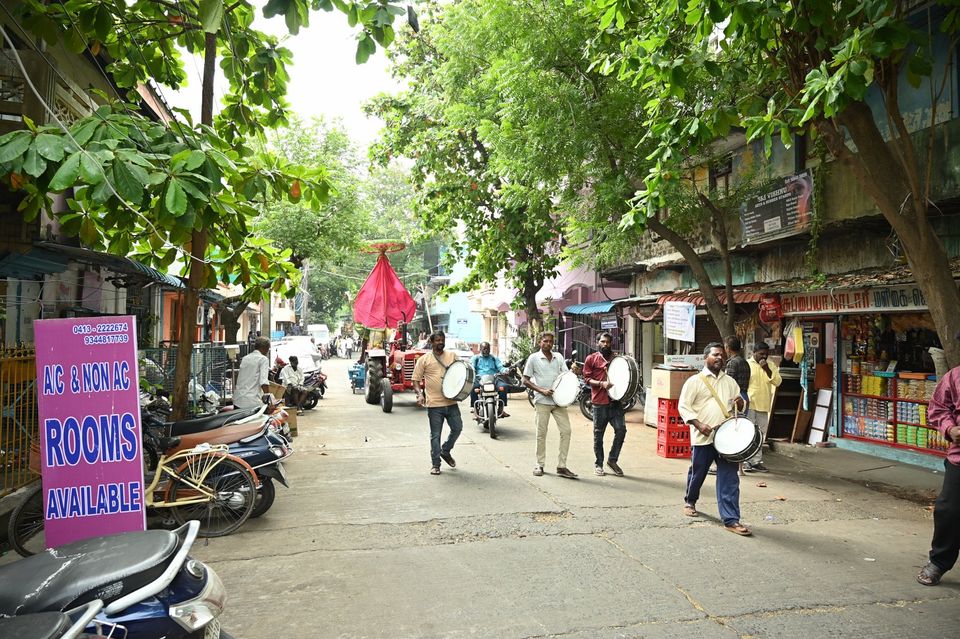
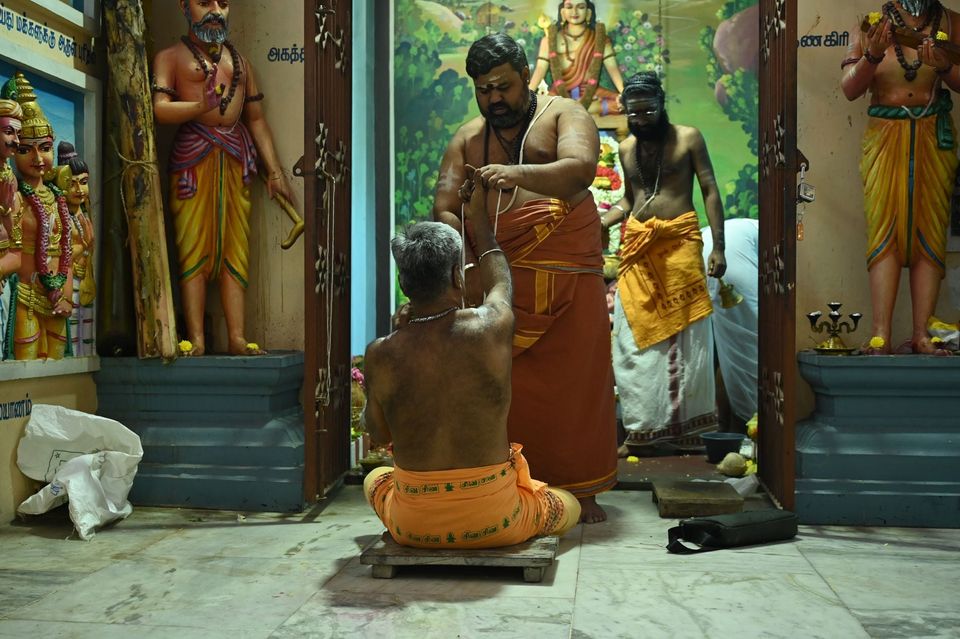
All other utsavars are then raised on shoulders and taken to the yagasala for the “Veerabahu” kaappu, wherein “Veerabahu” referred to the group of men donning green veshtis and who take care of the Navaveera shrine. These men are all presented with yajnopaveethams, perhaps only for the duration of this festival, and were tied with kaappus. All deities were given one more aradhanai, and proceeded towards the entrance. We were all asked to step out of the temple to witness the Gopura Darshanam. The temple gates were closed and opened to the devotees’ chants of “Vettrivel Muruganukku Harohara”, revealing anew the deities in their grand procession for the night.
More from Lawspet Murugan Koyil

Lawspet Murugan Koyil · Kanda Sashti Vizha Day 8Lawspet Murugan · Kanda Sashti Vizha Day 8

Manjal Neer Utsavam

The month Karthikai began today, and Lawspet Murugan Koyil celebrated this with the Manjal Neer Utsavam. Although called an utsavam, it seems to exist today as a far more diminished event. We reached around 730pm and found the usual pre-purappadu aradhanai going on for the utsava murtis. At the end of this, apart from the two regular elderly odhuvars, song was offered by a young girl who seemed to be the ubhayakara’s daughter. Upon completion she was given reassuring smiles by the priests and elders. This was followed by an elaborate vadyam offering made by three nadaswaram and two thavil players. They played three ragas as Sriram Gurukkal announced them. One of them was the Aadu Pambe tune also played for the Thirukalyanam on the night before, which seems a real performer’s favourite at temple events – though now that we did not have the dancing priests to grab all our attention (!!) we could focus a little on the winding serpentine inflections of the song. With the music session then wrapped up, the purappadu began. One round of the prakaram, then out onto the streets. We were a little confused about the ‘Manjal Neer-ness’ of this all, and upon enquiry found that that was a small event before the aradhanai where manjal-water was sprinkled on the deities and devotees. So not much of an utsavam, but something nonetheless, perhaps remnant of a grander past existence which may have given it its name.

Read more
Lawspet Murugan Koyil, Vedapuriswara Koyil · Kanda Sashti Vizha Day 7Lawspet Murugan, Vedapuriswara · Kanda Sashti Vizha Day 7

The Sheer Fun of the Old India

The morning at Lawspet was a panchamurti abhishekam which we couldn’t make it to with all the weddings happening in town, but it happened there late (we were told) and the dhvajavarohanam also happened. One of the gurukkals told us to save our energies for the evening, which we rather gladly did. In the evening, Valli and Devasena (or Devayanai, Devyani), were taken to a house in a nearby street–where the family of Murugan arrived to “see the girl” (ponnu pakkaradu). Having seen and apparently liked them both, the procession carried the brides both back to the temple, coming around the madaveethi as usual. Arun followed them all the way, I met them near the small Vinayaka koyil on the main road where the Samharam had taken place. All the ladies accompanied as is the custom, and they had enlisted all the younger girls, including some very cute looking very young ones to help out. They all stood holding plates and trays filled with fruits and sweet things, weighted according to carrying capacity, the little ones especially looking so pleased to be included and their participation so sought. It was a lovely sight to behold. They waited outside the temple, brides behind them, until the priest’s wife, herself with an infant on her hip, did an arati, poured the red water under the pallakku being borne, and then everyone entered the temple. They went left to the back where the homa kunda and other prep for the wedding was set up. There was barely moving room anywhere in the temple.

Read more
Lawspet Murugan Koyil, Ghousiga Balasubramaniya Koyil, Chetty Koyil, Vedapuriswara Koyil, Angalamman Koyil · Kanda Sashti Vizha Day 6: SashtiLawspet Murugan, Ghousigabala Murugan, Chetty Koyil, Vedapuriswara, Angalamman Muthialpet · Kanda Sashti Vizha Day 6: Sashti

The Greatest Battle of Them All: Soora Samharam

Many temples mark today in some form. Angalamman Koyil does a Murugan Abhishekam and maha deeparadhanai in the morning. Vedapuriswara, anticipating this day, does a 7am-5pm 36-time recitation of the Kanda Sashti Kavacham, on top of the daily 7am Balamurugan abhishekam, and later Murugan abhishekam, evening parayanam. We saw the arrangements made outside the Chetty Koyil for the samharam, and the bells still ringing at 11pm as we passed by en route to Ghousiga, but we have no images of these events. Our morning was spent watching the procession at Lawspet and the raising of the kodi that was the spine of Vajrabahu, on which the Navaveerangal would climb later in the evening to sing songs of Murugan, Siva, and Amman (Parashakti). For being the gigantic spine of an asura, this structure was treated with significant reverences. Turmeric was applied, vibhuti and kunkumam, flowers. A small bell at the head represented Vajrabahu’s skull. Flowers. I was told to be careful not to step on the ropes that would be used by the waiting crane to haul this into position. This sort of reverence had either got to be purification –or acknowledgement of Vajrabahu’s having now become one with Murugan. A smaller wooden piece was first placed in a waiting hole in the road (the hole must always be there, just closed up the rest of the year and opened again for the festival) – the hole was anointed of course, by Sriram Gurukkal, with turmeric water, milk, chandanam and the like. Then the short pole p

Read more
Lawspet Murugan Koyil, Ghousiga Balasubramaniya Koyil, Nandhikeswara Koyil · Kanda Sashti Vizha Day 5: PanchamiLawspet Murugan, Ghousigabala Murugan, Nandhikeswara · Kanda Sashti Vizha Day 5: Panchami

The Battle Continues and Murugan Gets the Vel

Crowds are slowly gathering as the festival tends towards Sashti. Though the day proceeds through some now familiar motions – abhishekam for moolavar and utsavars in temple, abhishekam for the Navaveerangal, the vel’s pradakshinam, the movement of the decorated utsava murtis outside to be seated on the vahanas, their procession through the madaveethi with so many houses alive and ready to meet them enroute. They arrive on the main road near the small vinayaka shrine that was perhaps once on the side of the road, but now finds itself in the middle. No matter, one side of the road is set up with keeth roofing at two ends – the Sooran Kottai as it’s called on one end, and the place near the temple for Murugan and the Veerangal on the other. I walk and talk with Siva enroute. He makes many interesting observations about how their group has built this temple’s traditions, or kept them going at any rate, starting from the time of the last Kumbhabhishekam in 2018. Prior to that, there was only Veerabahu as an utsavar, no moola murtis, and none of the other utsavar figures. Now their group of about 15, all of them from the area, many working elsewhere, return every year for this festival – they take care of navaveerangal abhishekam twice daily, and all matters involving the purappadu as well as the ritual enactments that happen. Siva doesn’t speak of a continuous lineage easily handed down, but one which they have had to wrest and claim as their own. Parents had other priorities, fin

Read more
Lawspet Murugan Koyil, Ghousiga Balasubramaniya Koyil, Nandhikeswara Koyil · Kanda Sashti Vizha Day 4: ChaturthiLawspet Murugan, Ghousigabala Murugan, Nandhikeswara · Kanda Sashti Vizha Day 4: Chaturthi

May the Battles Begin!

Yanaimukha Samharam at Lawspet. Our morning begins at the Yaga Sala where a new Veerabahu member, perhaps coming from afar and unable to join from day one, gets his yajnopavitam and kaappu. He then joins his brothers outside the Navaveerargal shrine from where they proceed on their routine Vel procession. Not needing to document this recurring procession once more, we drift towards the purappadu-ready deities sitting outside their alankara mandapam. The deities are the same processional ones – Vinayaka, Veerabahu and his brothers, and Murugan with Valli-Devasena. Also tentatively part of the formation is the astra murti no taller than a foot. Its Murugan is no taller than half a foot, and his two consorts are at most one-third. This astra murti only oversees the twice-daily bali offering. We also observe the serpentine form that adorns Vinayaka’s arching thiruvachi – two serpentine bodies beginning from either ends of the arch, joined by a single serpent head above and behind Vinayaka’s. We are uncertain whether it is indeed a serpent or mere adornment that suggests and invokes that resemblance – both of which find resonance with our earlier exploration of the Pavitrotsavam. The procession deities are soon lifted, taken around the prakara, venerated at the Yaga Sala where the concluding purnahuti is performed, and are brought out with a Gopura Darshanam to face Yanaimukhasooran who waits tall outside. The sooran is elephant-headed with four tusks capped with golden embellishm

Read more
See all field notes →