← Field notes

Preparation for Tomorrow’s Celebrations

This evening, the preparatory pujas for Kannika Parameswari’s annual celebrations start. It’s their 11th year, a Kumbhabhishekam is due, everyone says. There are a few ladies around, but the focus of activity is on the ubhayakara and his wife (he’s a Perumal bhakta, someone says; it’s true we’ve often seen him there). The kalasas are out on a stand facing west, and in front of them the usual thonais representing the navagrahas. The priest is reading a namavali, and the couple are jointly putting flowers on the kalasas. They switch eventually to the conches, circling the 108 slowly: she places flowers, he pours water with the panchapatra udharini slowly, I suppose ceremonially (the conches had already been prepped with water, flowers etc.). He had a koorcham bunch in his hands, too. (The conches are set up on a table outside the main sannadhi, and beneath them are three new calendars for 2027). The puja continues, seated, and then circumambulating the kalasas. Homa kundam has been set up for tomorrow’s use, the largest and tallest we’ve seen yet.

Several ladies there are passing by on their way to see Ghousiga’s theppal event. I feel rather happy to have access to live updates from Arun, and to be able to tell them exactly when the purappadu has left and when it might reach the Sivan koyil next door!
More from Kannika Parameswari Koyil

Kannika Parameswari Koyil · Aandu Vizha Day 2Kannika Parameswari · Aandu Vizha Day 2

Homams Taller and Broader

It is the second and principal day of Kannika Parameswari’s Aandu Vizha. The morning begins at 530 with a Gopuja. Deepa gets there by 615 (just in time to have the hot paal-naivedyam from the milked cow, whose calf was now suckling rather vigorously), and Arun is still in bed sleeping through his alarm! Deepa catches the tail end of the Gopuja, after which unfolds the long array of homams. The sequence is: Vedaparayanam, Ganapati homam, Aalaya Parivara Devata homam, Sri Kannika Parameswari Gayatri homam, Moolamantra homam, Sri Lalitasahasranama homam, Sri Parvati Svayamvara homam, Santanagopala homam, Dhanvantiri homam, Purnahuti homam. Among all our temple visits, this is the broadest variety of homams we have seen being done together. And to add to this, it is also the tallest homa-kundam, or fire-altar, we have ever seen! The priest sits to one of its sides, facing the sanctum, offering naivedyam into the fire. To his left are the ubhayakara couple, with the man offering ghee-oblations with the priest’s chants. To his right is the temple nirvagam head, offering oblations of diverse dravyams or substances as per the particular homam’s requirements. Just beyond the fire-altar towards the sanctum are five kalasams placed at a height. Below and in front, west of the kalasas, are the Navagraha thonnais, also on a short stool. And below even this, is a little manjal Vinayaka with an assortment of thonnais. Beyond even the kalasas is a table with the shankhas ready for the subseq

Read more
Kannika Parameswari Koyil · DeepavaliKannika Parameswari · Deepavali

Laddoo Alankara and Dhana Akarshana Puja

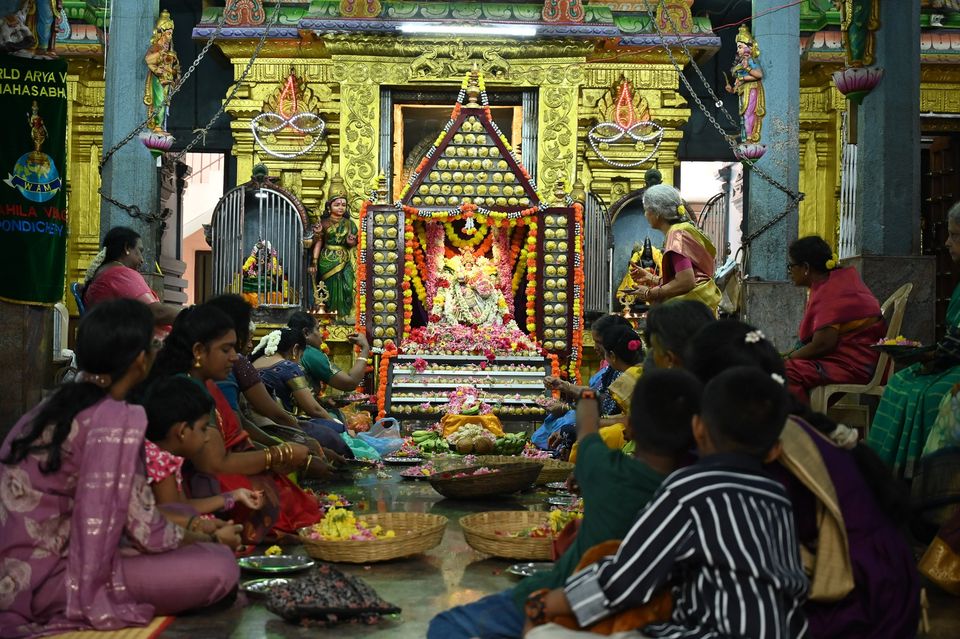
On Deepavali morning, Mahalakshmi gets a laddoo alankaram – just as in some temples, a laddoo ther is made and pulled on this day. When we reach, the puja is just going on, ambal in a white sari, spoon and pot in her hands (She is Annapurni), flowers over her, laddoos around her (in a “mandapa” that looks like it must just have been made for this purpose alone). Evening is the Dhana Akarshana puja, which is the only time in the year when the Kuberan yantra is pulled out of its separate shrine and brought out to propitiate. It sits now in the middle of the Western nave, facing East. The little Mahalakshmi utsavar is out again, with a manja-vinayaka (made out of turmeric) out directly in front of her and a kalasam. 9 thonnais for the navagrahas on a stool in front. The Yantra is placed on a green cloth I’m not sure of the significance of, and a thinner thundu-like bordered piece lining its very top. Malas. Kubera is traditionally associated with Pushya nakshatra (when the yantra abhishekam happens), and his role is not merely to bestow wealth but also to guard and distribute the treasures entrusted to him. There are mostly women present as usual, and they are seated in rows, but the ubhayakaras do the puja closest up and the rest of us participate from afar as it were. The Iyer (Subramanian) holds a book with the title Sampradaya Vrata Puja Vidhanam, chapter on Sri Dhanakarshana, Sri Lakshmi Kubera Pujai. Subheads: Sodadha Matrugana Pujai, Ganapatyadi Pancha Loka Pala pujai (ko

Read more
Kannika Parameswari Koyil, Vedapuriswara Koyil · Poosa NakshatramKannika Parameswari, Vedapuriswara · Poosa Nakshatram

For One, for All

On the day of Poosa Nakshatram, the Kannika temple has a 530pm Kuberan Yantra Abhishekam we’ve long wanted to see. Finally, we made it to this one. Just a single, young ubhayakara there–he or his family owns a jewellery shop, he is both event sponsor and priest’s aid, and he disappears as soon as the puja is done as his shop calls. Poosam nakshatram represents nourishment and flourishing; Kubera represents the guardianship and administration of wealth–I suppose this is why this particular puja is done on this particular day. Thursdays is an evening archanai for this same Kuberan Yantra and its smaller counterpart, sitting on the shelf in the small shrine to the right of Ambal, in which the Yantras are installed. The abhishekam is for Mahalakshmi also, because She grants wealth on Kubera’s command, explains the Iyer. He protects it, but She is the one by whose hand and will it reaches us. The Kubera Yantras both were apparently found on the building site of the temple, sometime before 1921. Kanchi Periyavar is said to have identified them. For a merchant community, this is a significant and meaningful find, so the temple honours the yantra in this way. But for all the other pujas attended by many groups of women and their families, nobody else is around for this one. Puts us in mind of what Thirukumaran once said: no audience is really required, but if the priest does what he is meant to, the whole world will be well. Alankaram is a simple affair, as is the puja. After it is d

Read more
Kannika Parameswari Koyil · Navaratri Utsavam, Vidaiyatri Day 6; KrittikaiKannika Parameswari · Navaratri Utsavam, Vidaiyatri Day 6; Krittikai

An Abhishekam (or Two) a Day…

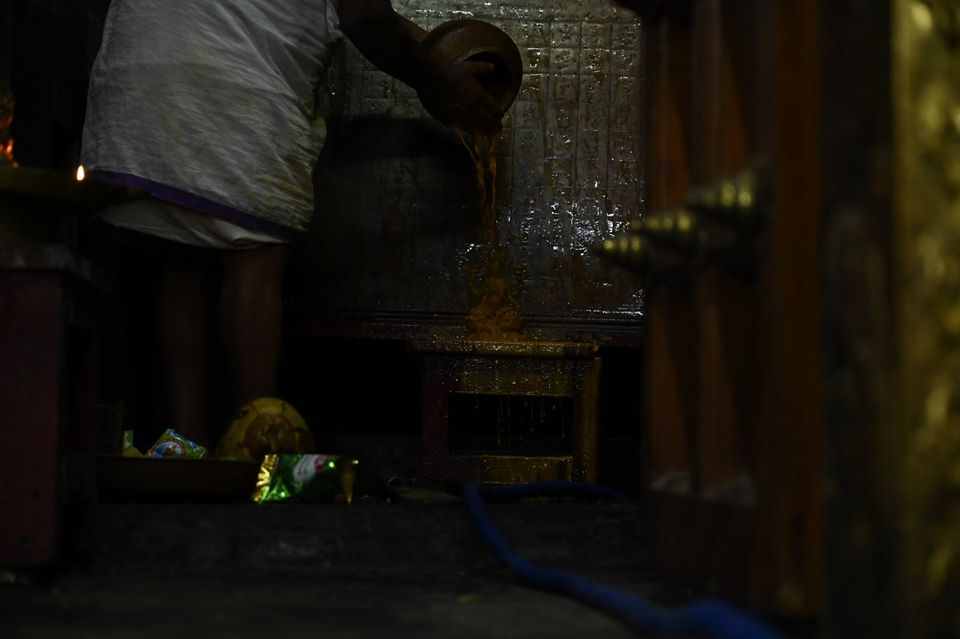
We were the only ones aside from the single ubhayakara at this morning’s Kannika Parameswari Krittikai Abhishekam. The usual dravyangal—oil, water (lots of it), abhisheka podi, 2 litres of milk, curd, 3 elaneer, rice flour, chandanam to be mixed with rose water. The priest works alone as usual, and chants the Purusha suktam, as well as Durga suktam and other verses I cannot make out, though Arun hears “Hayagriva” at one point. The alankara is simple-velli kavacham and flowers. It’s much like the vinayaka Abhishekam I had seen for sankatahara chaturthi, with gomathi masi. A no fuss affair. Small puja after and thinal or foxtail millet payasam. Traditionally made for Murugan this time of year, said the Iyer, a little makes a whole bucket. As we are leaving, they are calling the ladies filling the garbage truck outside to come in and have some. In the evening is an arati thattu competition— to be fashioned out of coconut leaves. So all the women’s entries are being registered when we arrive at 645pm, between the Sivan and Nandhikeswara krittikais. There will be a judging later. The nirvagam head’s wife comes to explain to me the rules, as she has seen us there often. Today is the last vidaiyatri day, so there is an extra air of festivity and perhaps a sense of relief. 17 days!! 17 days you’ve also enjoyed — says the lady who is active at the mahila sangam, who is always kind to us. Indeed. There’s a second Abhishekam to Murugan going on. The morning one was early—Krittikai reall

Read more
Kannika Parameswari Koyil · Navaratri Utsavam, Vidaiyatri Day 5Kannika Parameswari · Navaratri Utsavam, Vidaiyatri Day 5

Thiruvilakku Decoration and a Lying Down Ambal Alankaram

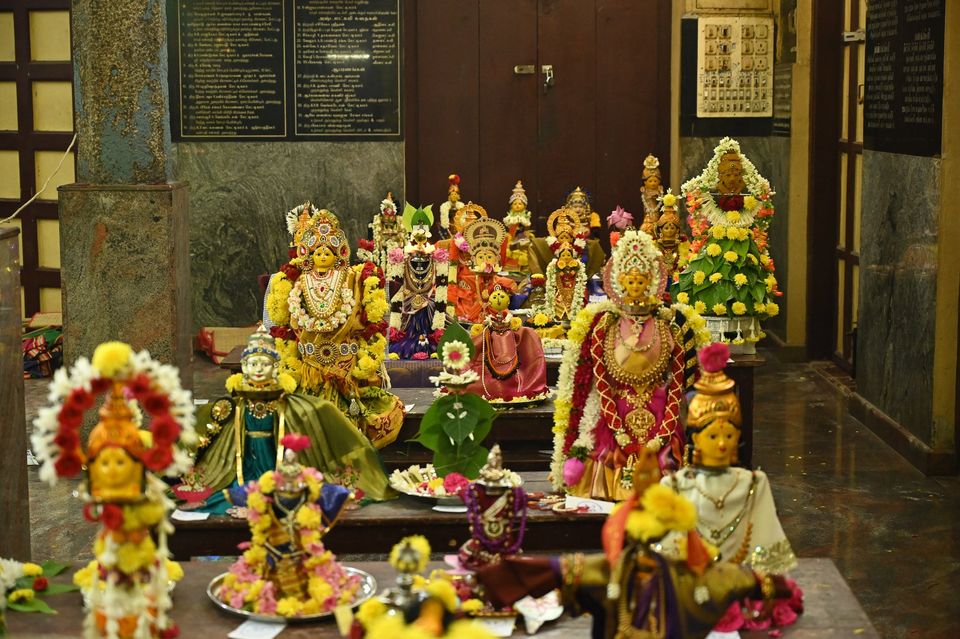
The security guard saw us and called us in from the road, I kid you not! It was hard not to stop, because the lying down utsavar right in front there looked very pleasing. The usual bevy of ladies gathered, chatting, reading, chanting. The Iyer doing his chants apparently in parallel. And along the whole left prakaram, rows of benches with numbered decorated lamps. My favourites were the one with the lime head and the roses for hair (many had pre-made faces, this did not), and the one that used ficus leaves to make a vinayaka form. Not sure which got the prizes though!

Read more
See all field notes →